

While to audiences today the word arcade may conjure up images of video game cabinets and redemption games, the concept of a gaming parlor goes back decades before Computer Space was ever a gleam in Nolan Bushnell and Ted Dabney’s eyes. Before video games, you had electromechanical machines like Sega’s Periscope or Williams’ United Century Bowling Alley. And alongside those –and for decades earlier – you had pinball.
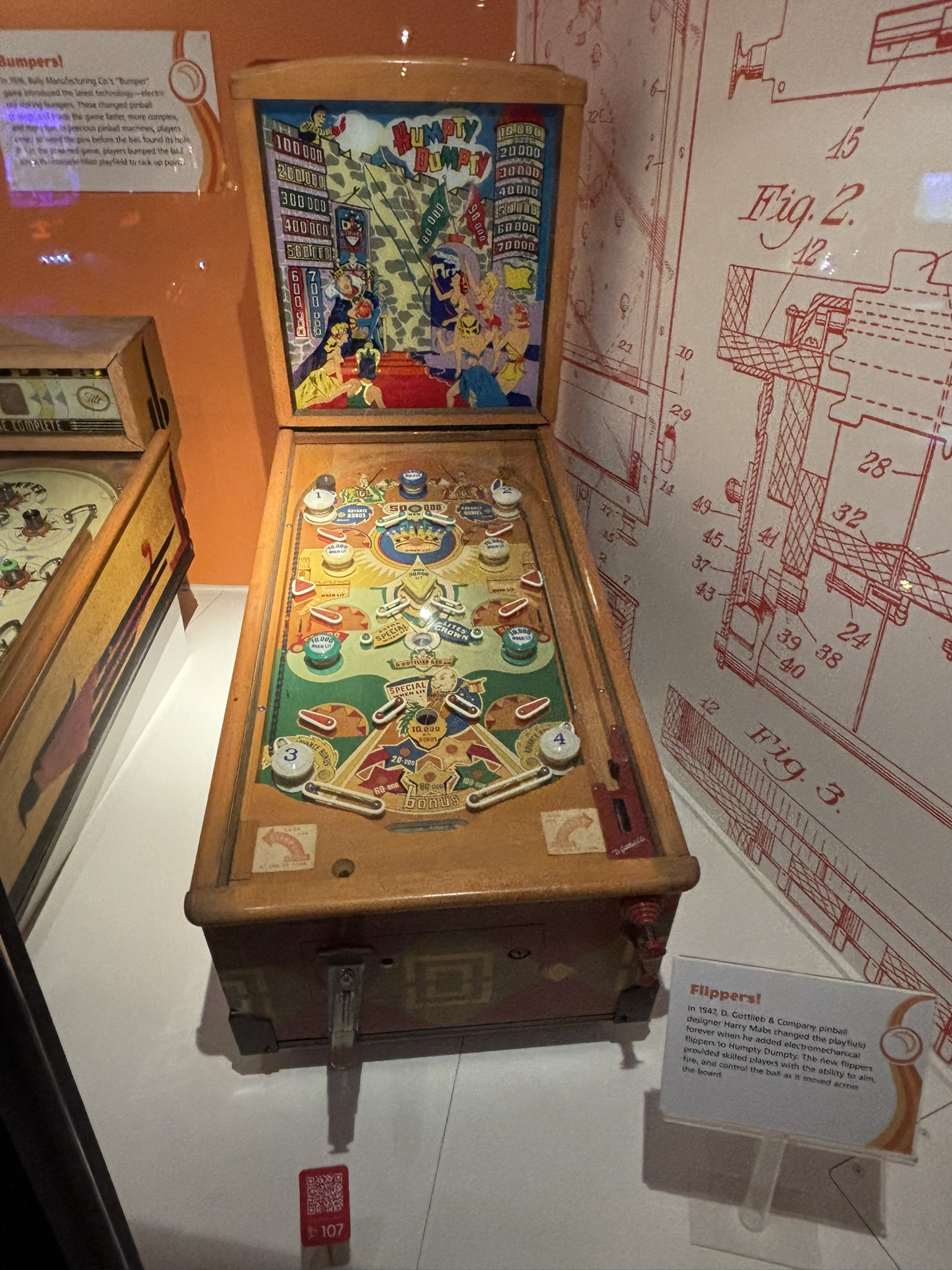
Pinball is still a pretty popular mainstay in arcades and bars, with new machines still being produced and local leagues popping up to help people learn how to play and compete for high scores. The history of pinball is incredibly rich and could even count machines like the bagatelles of the 1700s; I’m not sure I could necessarily do it justice, though there are books and sites that do a pretty solid job. But for some highlights, 1931’s Baffle Ball marked the first shift from these bagatelles to the modern concept of pinball, being among the earliest coin-operated version of these tables and certainly the first to be widespread. The following years would see the electrification of these tables, with electrically-powered solenoids creating sound effects and spring effects off bumpers; in 1947 Humpty Dumpty introduced player-controlled flippers, giving people more opportunities to control the ball beyond nudging the table around. Pinball game design continued to become more refined over time, with the electromechanical era giving way to microprocessor-driven pinball machines in the 1970s. The postwar pinball boom period faded in the late 70s as video games grew in complexity and visibility, but there remained diehard interest in these more analog experiences that would eventually lead to new booms in subsequent decades. And within gaming companies, there was interest in trying to marry pinball design with this new video technology – both to appeal to players and to help operators save on space, as even a small pinball table takes up enough real estate for an adult to lie down under.
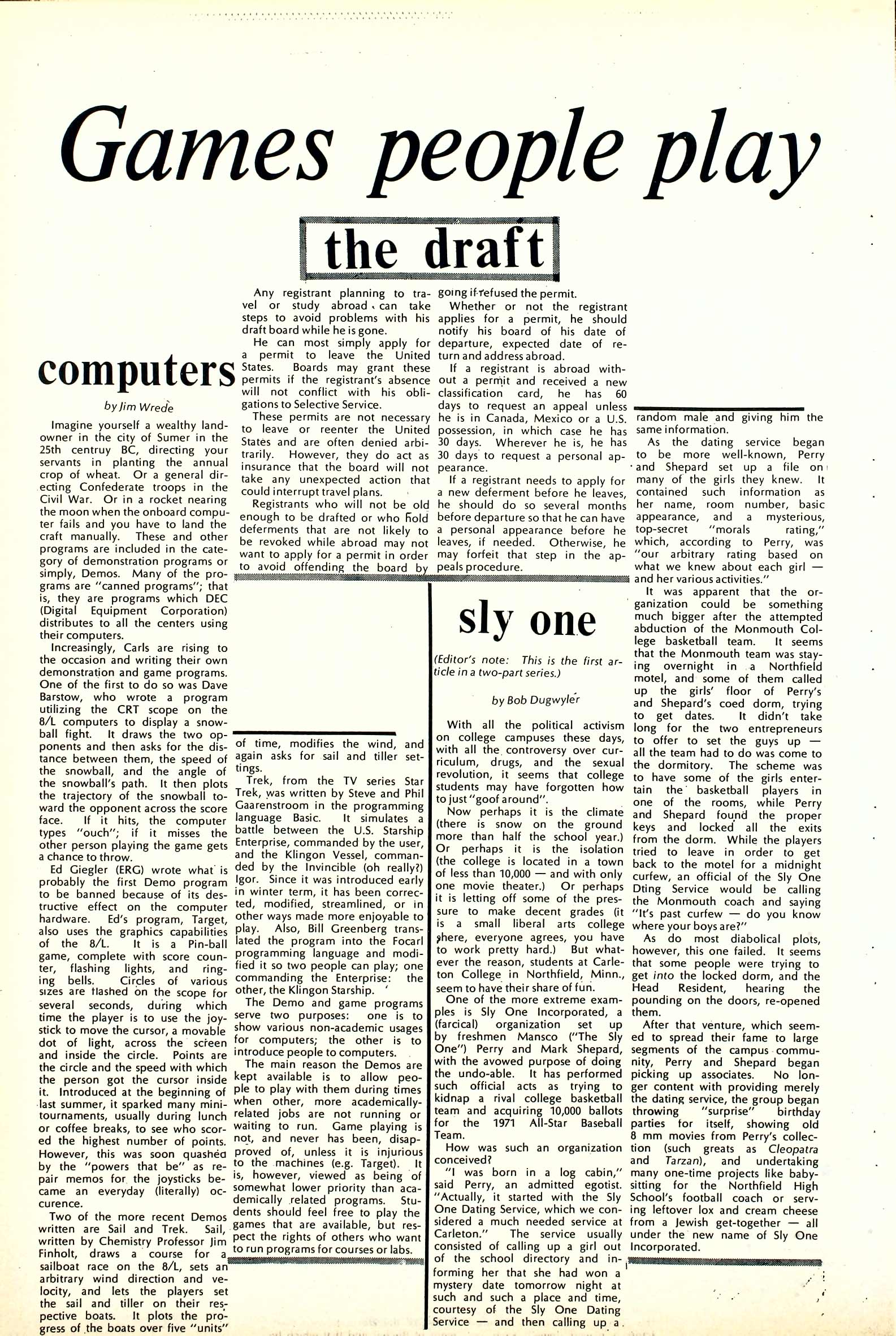
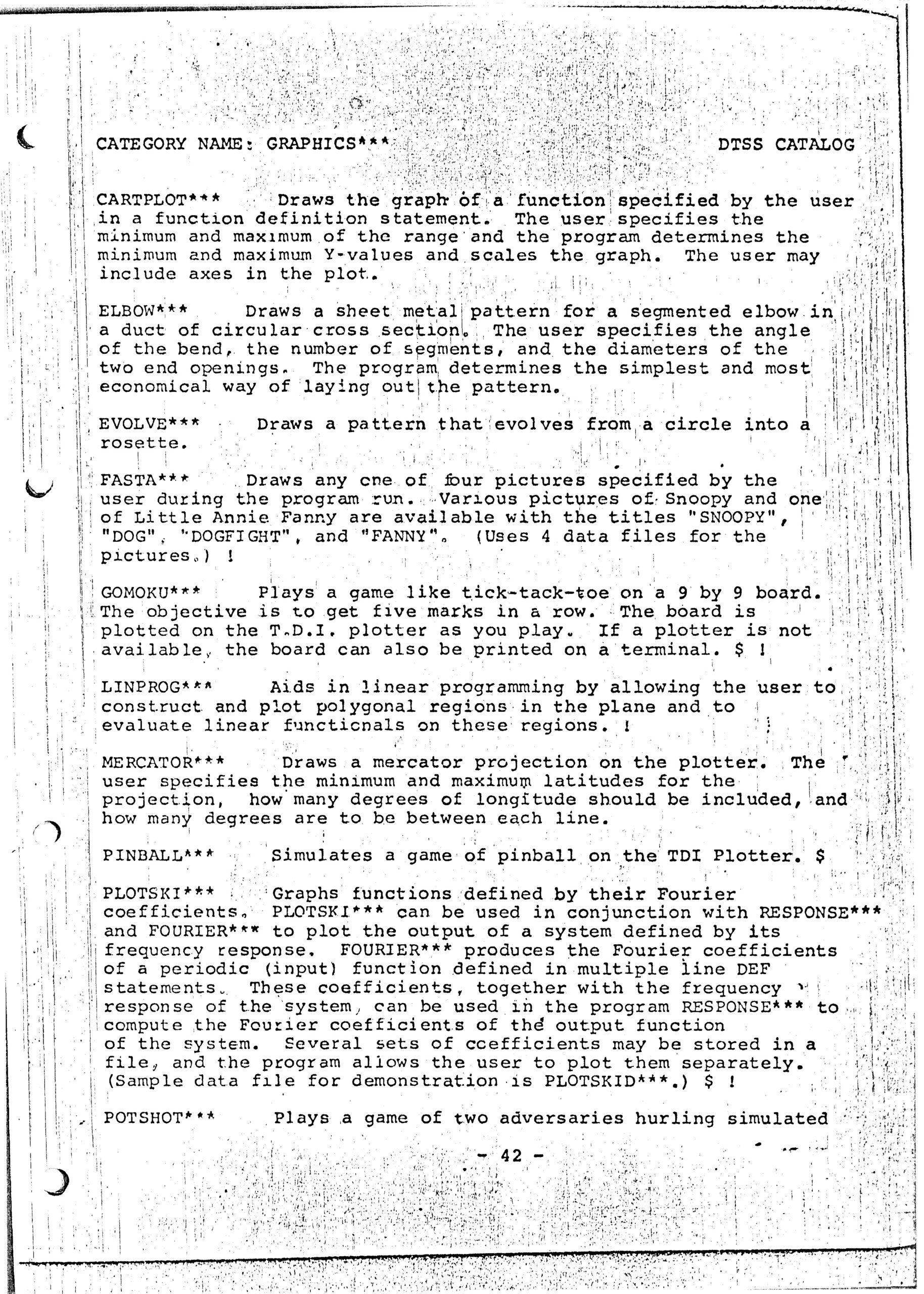
According to its author Bob Smith, Atari’s Video Pinball isn’t related to any of the early attempts a video game pinball tables, but I think it’s important to recognize how this genre started and developed in the years leading up to its release to understand how his game fits contextually. There are a couple early references to pinball games on computer systems that have emerged over the years; a 1972 program guide for the Dartmouth Time Sharing System lists a plotter-based game called PINBALL that, from the description, sounds like an attempt to run a table using the same underlying technology as Arthur Luehrmann’s POTSHOT (both are lost programs as of this writing). Going slightly earlier, a pinball-esque computer game called Target was described in a 1971 edition of the Carletonian, where players control a cursor and try to hit flashing targets. But when it comes to video pinball as a commercial project, Atari itself pioneered the genre with 1974’s Pin-Pong. This is a remarkable attempt at simulating a pinball machine before even microprocessors were being used in video games; to that end, Pin-Pong is entirely done with discrete logic.
1974 was also when the Pong boom was dying down and game developers started thinking of ways to move beyond its design, which led into to the “paddle pinball” subgenre, where the flippers are replaced with a pong-style paddle. These are rather similar to Atari’s arcade hit Breakout, which exists as something of a cousin in this family tree. Much like Breakout, these games appear to have their origin with – or at least were influenced by – Ramtek’s Clean Sweep arcade machine, in which players move a paddle along the bottom of the screen to knock the ball into dots across the screen. Ramtek sought to follow this up with Knockout, which introduced bumpers, pockets along the walls and a moving target to aim for. Ramtek ultimately didn’t release this game themselves, but they licensed it out to Midway, which appears to have released it as TV Flipper, while Exidy released a clone – potentially licensed, though it’s unclear – under the name TV Pinball. Chicago Coin essentially married the flipper and paddle pin aesthetics together with its game Super Flipper; this 1975 arcade machine features paddles, but these are operated essentially like normal pinball flippers using buttons on the sides of the machine. Paddle pinball machines essentially culminated with Namco’s Gee Bee trilogy (Gee Bee 1, Bomb Bee, and Cutie Q) in 1978 and 79 and rapidly fell out of fashion afterwards, as the technology was there now to make more realistic attempts at pinball.
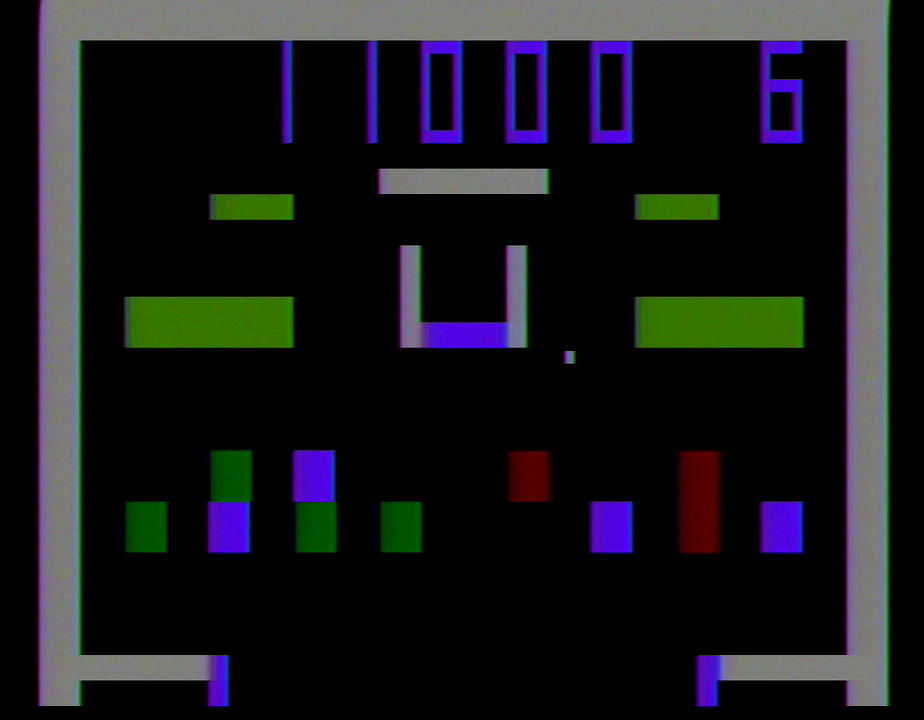
Once again, Atari was the trailblazer here, with three games that were all somewhat confusingly called Video Pinball. The first was a dedicated console released for the holidays in 1977 that featured both paddle-pin and flipper pinball games, as well as two versions of Breakout. David Ahl gave it a rather descriptive review in Creative Computing, where he noted that by this point no other home video game manufacturer had attempted pinball before describing the game itself. Video Pinball features two playfields for both the paddle and flipper pin modes, a basketball-esque “Rebound” mode, and of course, Breakout, which was at the time a hot and relatively new arcade game, having debuted the previous year. It plays a pretty good version of all of these, as well, and relevant to this piece, the pinball games provide a good number of targets to aim for. While this machine is particularly cool for a dedicated console, coming out when it did meant that it was really near the tail end of dedicated consoles being more than a low-end market novelty. 2
And Atari would reuse the name for an arcade machine in 1979. This Video Pinball uses an overlay on the screen to create the table’s visuals, while the graphics themselves are projected on to create the impression of 3-D imagery on a rather small video game cabinet that could fit into places a full-sized pinball machine never could. According to an interview with developer Ed Logg in the pages of Retro Gamer, this overlay was a design choice to make the game convertible into new tables – operators could ostensibly swap out an EPROM on the game board and change the art and have an all new playfield, even though this would never be used in practice. While the game did moderately well, Logg said it wasn’t the kind of hit Atari was looking for. But Atari would have that hit in the console space when it published the third Video Pinball game in 1981, this time for the VCS.
In the case of programmable games, however, Atari was playing catch-up after a fashion. 1978 likely saw the debut of Pinball for the RCA Studio III clones produced and sold outside of North America by the Hong Kong-based company Conic. Developed by Andy Modla at RCA before the company ended its foray into home video games, Modla said this was a pretty good simulation of a pinball machine for the hardware, even featuring the ability to “nudge” the machine and tilt it if overused. Of all the games he did, Modla has said this was his best. And it’s hard to disagree – it’s rather playable today, and works pretty well with the Studio III’s keypads. And like all Studio III games, it is backwards compatible with the Studio II, though the slight differences in the cartridge shell can make it a tight fit if you try importing a copy.
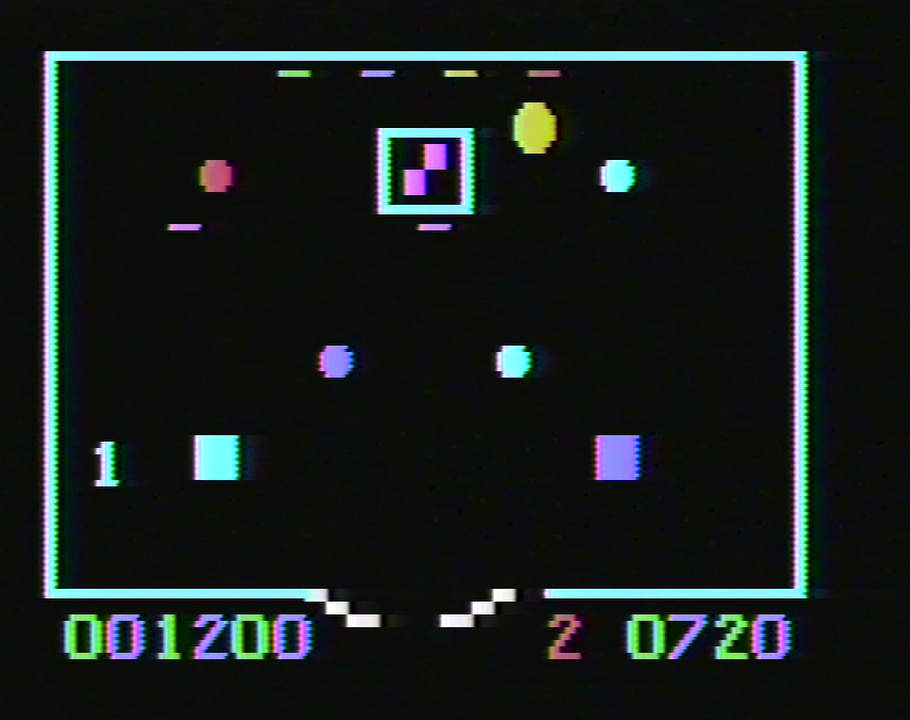
But whether or not Atari was aware of Modla’s game, they were undoubtedly in the loop on another two commercial pinball games released in 1979. The first was Thunderball! for the Magnavox Odyssey2, which is admittedly kind of awkward to play due to the large size of the ball and the unintuitive way in which it moves. Weirdly the game lets players shift the flippers left and right slightly to avoid there being a dead zone in the middle that makes the ball impossible to hit, which is an interesting workaround for a game that is really on the cusp of being pretty good – though unfortunately, it falls a bit short. This was incidentally the second pinball game developed for the Odyssey2 – one of the co-creators of the original Odyssey, Ralph Baer, worked with his team on a pinball game to help convince Magnavox that it was worth selling the Odyssey2 platform when it was nearly canceled before release, though it wouldn’t be released until autographed reproductions were sold at the 2000 Classic Gaming Expo under the title Ralph Baer’s Pinball! This has a very nifty feature of letting players design their own table years before Bill Budge’s famous Pinball Construction Set computer program, though its lack of a contemporary release or any save feature means this didn’t amount to much.
The other 1979 home pinball game was Bally Pin, released on the Bally Professional Arcade.3 Written by Bob Ogdon, this was his first game after coming to Dave Nutting Associates as a developer and was conceived while he was stuck indoors for a month due to a major snowstorm. As a math major, Ogdon told me it was pretty straightforward to come up with the math the game uses for the ball’s movements; sporting two different tables and a nifty two-controller setup to manage the flippers it’s a top-notch game that Ogdon remembers being relatively popular… for a Bally Arcade game, anyway.
All of these events lead up to the VCS Video Pinball title, as Atari’s new hire Bob Smith took on the project of making a pinball game for the VCS in 1980. Smith was not originally a programmer – while he had taken some computer courses in college, he was not a fan of the punch-card input methods at the time and went into building things instead. Smith was working in a lumber yard in New Mexico in mid-70s when he convinced them to get a Sol-20 kit computer, wherein he rekindled his interest in computers by learning assembler for the Intel 8080 microprocessor it used. The kit came with a couple games that Smith said were kind of stupid but got him interested in video games, so while coding at the lumberyard, Smith came up a program that he described as similar to Night Driver, with a behind-the-car view. He would later get a hold of a TRS-80, which had more advanced graphical capabilities, and finished his game on that before selling it to the magazine Creative Computing. Smith said his wife, originally from the San Francisco bay area, was getting homesick, and so they moved back to California and Smith started looking for programming jobs. He interviewed at a Swiss power grid company and at Atari, wherein he was given the choice of developing games for the coin-op or consumer departments – he chose consumer, as he was self-taught and felt like that’d be easier to get by with in the home division. At 30, Smith was the “old man” of the development team, with only his boss, Consumer Division Software Manager Dennis Koble, being in the same age range.
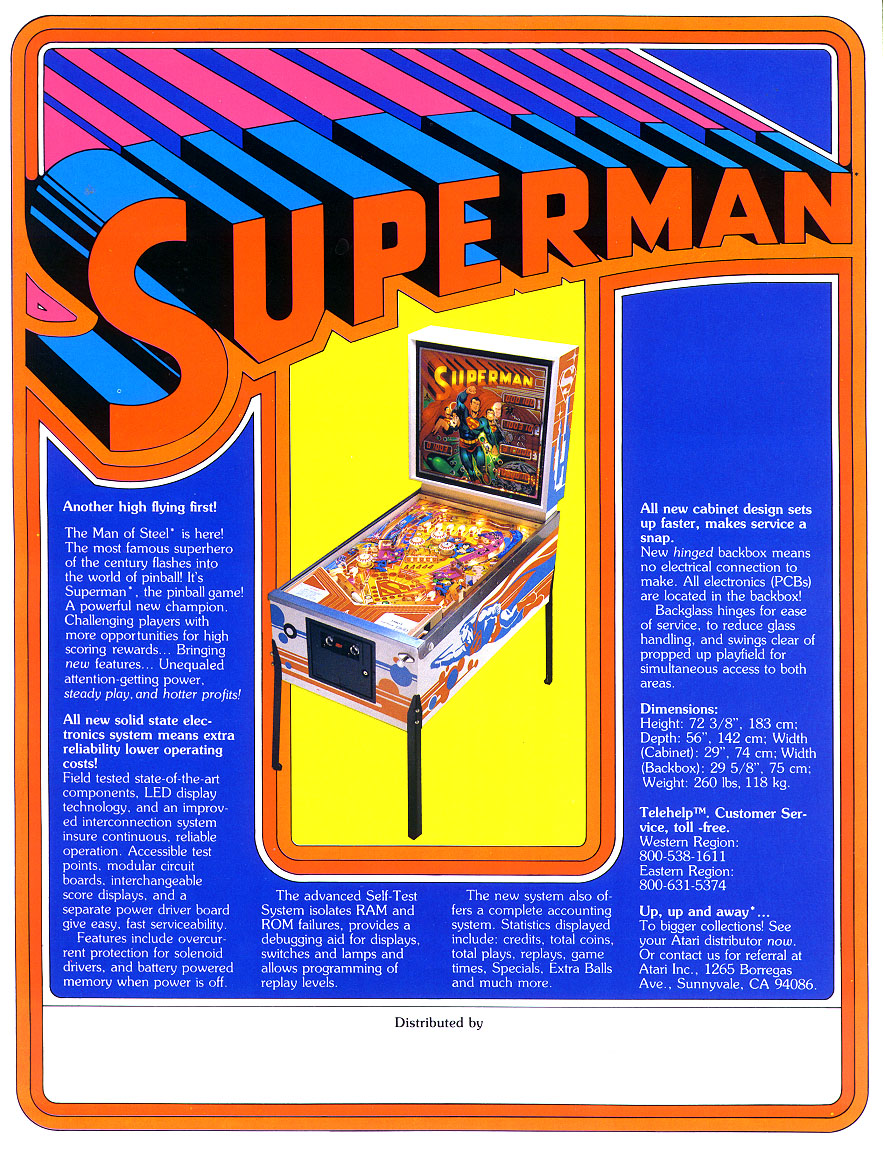
Upon being hired Smith was given a list of VCS program ideas that had been floating around to pick one for his first project. Smith chose the one at the top of the list, pinball, reasoning that it must have been a priority since it was so high up. The problem here was that Smith was not really a major pinball player, so to familiarize himself with the genre, he spent hours playing the Superman pinball machine at Atari’s corporate game room, learning how a pinball table handles point progressions. These were the most interesting aspects to Smith, who tried to implement them into his own game. Due to space limitations Video Pinball doesn’t have a true physics engine, Smith explained – it simply is taking into account speed, gravity and rebounds to keep the ball moving. For that matter, the ball never actually stops. The ball actually can move so fast that the VCS’s built-in hardware collision detection couldn’t be used, forcing Smith to work that in software and occasionally causing the ball to fly right inside or through objects as though there is nothing there at all to stop it. He also wrote his own sound routine for the game, explaining that while most VCS games use algorithms to generate sound, Video Pinball uses what he called “cable driven sound” for its effects, which ended up using 100 bytes of the 4 kilobyte cartridge. Smith said it took him about a month to shrink his program into 4k of memory without glitching, with the final program completed around May or June of 1980. In the end, he showed his game to Mike Albaugh, a longtime coin-op developer, who remarked that while it wasn’t pinball, it played well.
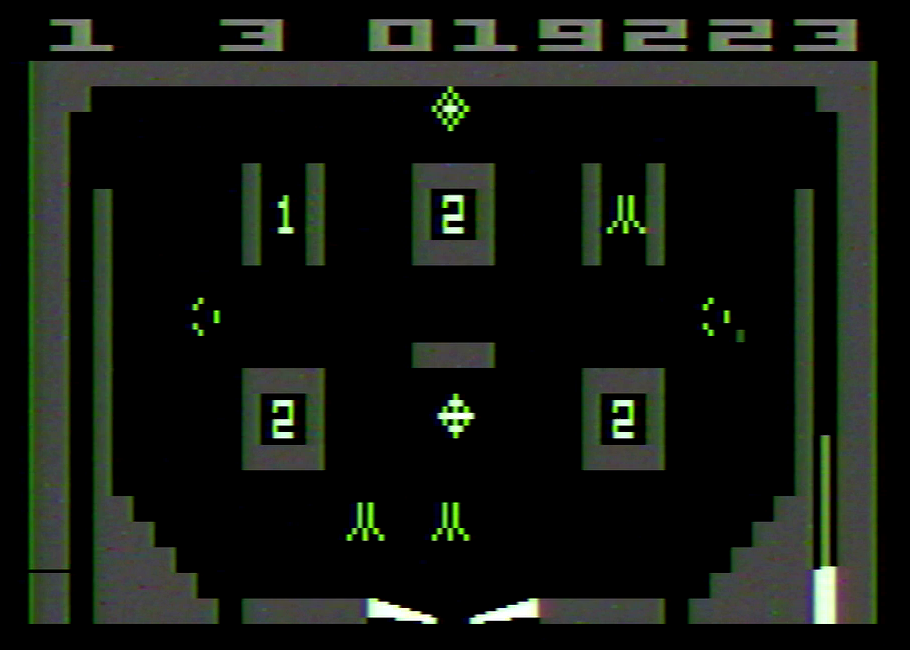
This is a pretty good description of Video Pinball. At first glance it’s a very strange looking table, with this flat floor, a plunger on the right, a gutter on the left, and a handful of bumpers and spinners in the middle of the screen. If the difficulty switch is flipped to A, there are also two outlanes on either side of the flippers that the ball can drain out of. The flippers themselves sit passively in the center with the drain between them; pushing left or right on the joystick will cause one or the other to raise, while pushing up brings them both up at the same time. The way the ball careens around the screen means that the flippers may not come into play as often as you’d think, though it does gain quite a bit of momentum with a good flipper strike.
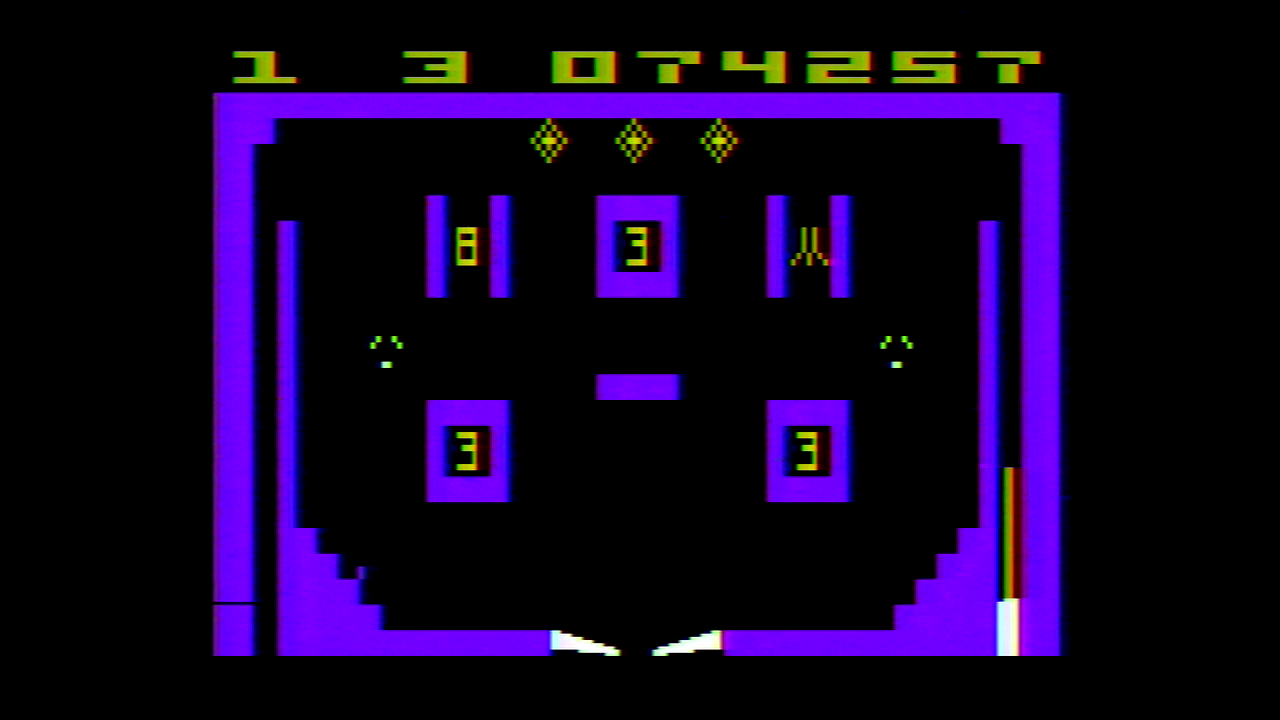
The playfield also includes three large bumpers, which start off with a 1 in each of them, which denotes that they are worth 100 points per hit. By hitting the three drop targets at the top of the screen on one ball, these will increase in value by 100 points. On games 1 and 2, these value increases stick around after you’ve hit the drop targets, but on games 3 and 4 these will reset back to 1 after you’ve lost a ball. Beefing up your bumper values can boost your score significantly, so they are worth trying to hit. Around the bumpers are two rollover targets – one with a number, and one with the Atari logo. Rolling the ball over the Atari logo will increase your bonus multiplier for when the ball drains out and earn you 100 points; hitting it four times in a single ball earns you an extra ball, denoted by a large X in the middle of the screen. The left rollover 100 points per hit, and will give you 1000 additional points when you lose a ball, up to a maximum of 4000. Finally, there’s a lit target that pops up every so often in the center of the screen for four seconds at a time. Hitting that will net the player another 1000 points.
To assist in hitting these targets, Smith included the ability to “nudge” the machine by holding down the button and pushing a direction on the joystick. While the ball will still head in whatever general direction it was going in, as long as the nudge is active it will drift slightly in whatever direction you’re pushing. This can be particularly helpful for catching additional drop targets or rollover values, or for simply avoiding a drain. But like with an actual pinball machine, Video Pinball can “tilt” if you nudge for too long at a time, at which point you lose control of the flippers and stop collecting points. The game denotes this with a red backdrop to the scoreboard. This is a clever implementation of a real-world game strategy; while Modla made a similar attempt on the Studio III version at working in nudges, other early console pinball games simply lack it and are much more difficult and random games as a result.
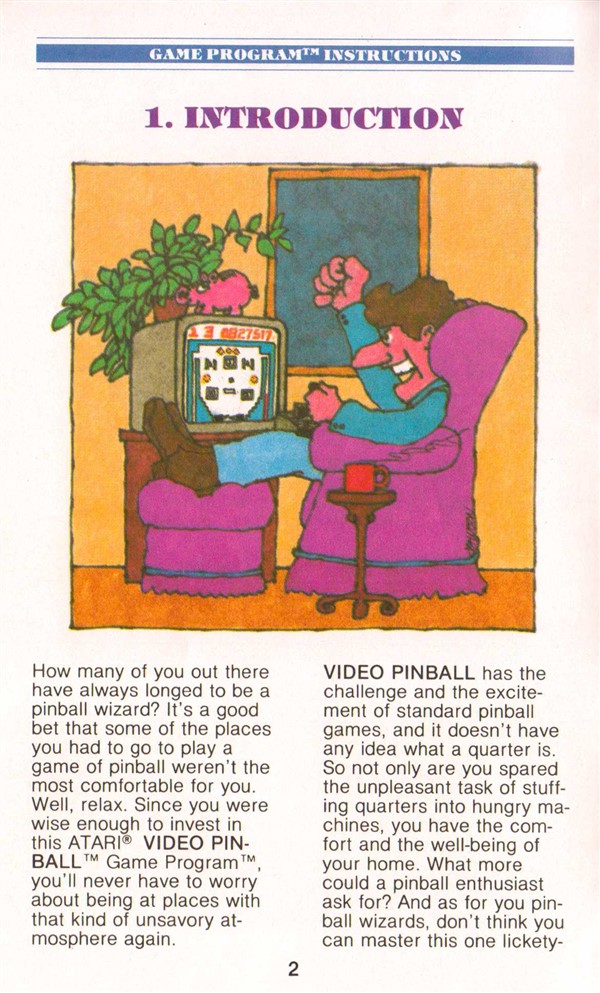
The manual once again returns to the goofy, MAD Magazine-esque artwork seen in other VCS games of this period, though instead of a strange backstory Atari’s staff simply write to the player as if they are someone who enjoys or is interested in pinball but doesn’t always want to go to the kinds of seedy locales pinball machines were located in at the time. It’s a remarkably sweet approach for this game that makes it seem like a fairly welcoming, laid back experience – which it certainly is, for better or worse. Video Pinball is not a particularly intense game, as even when the ball gets going you either have enough time to react to it with nudges or the flippers, or you don’t and it whizzes by you anyway.
Smith says that this was his most successful VCS game, selling to his knowledge around two million copies. He joked that Atari’s Consumer Electronics Division Vice President Mike Moone once told him that if the game sold more than two million copies, they’d hold the next creative session in Hawaii, and since that trip never happened, Moone therefore still owed him a visit as of our 2021 interview. We do know that it sold enough to be the 13th best-selling game on the memo showing cartridge sales from the Once Upon Atari documentary, though it cuts off before we can see for sure how it did. Between 1986 and 1990 Atari Corp sold around 36,535 copies of the game, which is pretty impressive given that the company had its new pinball game on the market at the same time.
Of course, one reason why that trip to Hawaii never happened for Smith was because he ended up leaving the company only a few months after Video Pinball came out. Flush with cash off of Space Invaders’ success in 1980, Atari went on a hiring spree, with some of the programmers being moved out to trailers in the parking lot. There, Smith started work on a Dungeons and Dragons-based VCS game, playing sessions of the tabletop RPG with his officemate Carla Meninsky and a couple other programmers like Nick Turner to brainstorm and design the game. He didn’t get very far with this effort, however – Smith was roped into becoming the new consumer software manager at the suggestion of Koble, who was promoted to director of software development – and was also planning on leaving Atari to form what would become Imagic, another third-party game publisher. Smith spent about a year as the consumer software manager at Atari before leaving the company for Imagic in mid-1981, being present at its founding in July. There he would produce several well-regarded VCS games, though nothing, he emphasized, was as big as Video Pinball.
Before he left the company, however, Smith was also brought into the ill-fated Atari 3200 Super Stella project. This unreleased game system was touched on at length in the Steeplechase article but, in short, this was being designed as a step-up system featuring more memory, upgraded ICs and a voice synthesis module, but ended up being canceled due to fatal design flaws. For this project, Smith was asked to write test code for the analog joystick – a physical design largely reused for the 5200 video game system – followed by writing a baseball test game. While it looked good with high resolution graphics and a full nine players on the field, under certain circumstances the machine would completely crash. As far as Smith could tell the error was in one of the new chips in the design, and he wrote the memo about it that, as he put it, ended up killing the project.
Pinball video games would continue to develop in the following years, routinely producing titles that emulated those physical machines more closely than Smith’s attempt, both on the VCS and elsewhere. In the computer space the biggest developments came from Bill Budge, who created the acclaimed Apple II games Raster Blaster and Pinball Construction Set; these really proved how good a video pinball game could be, with the latter giving users the ability to craft and save their own tables. Other notable computer games at the time include David’s Midnight Magic and Bumper Bash, both of which had their own VCS variations in later years.
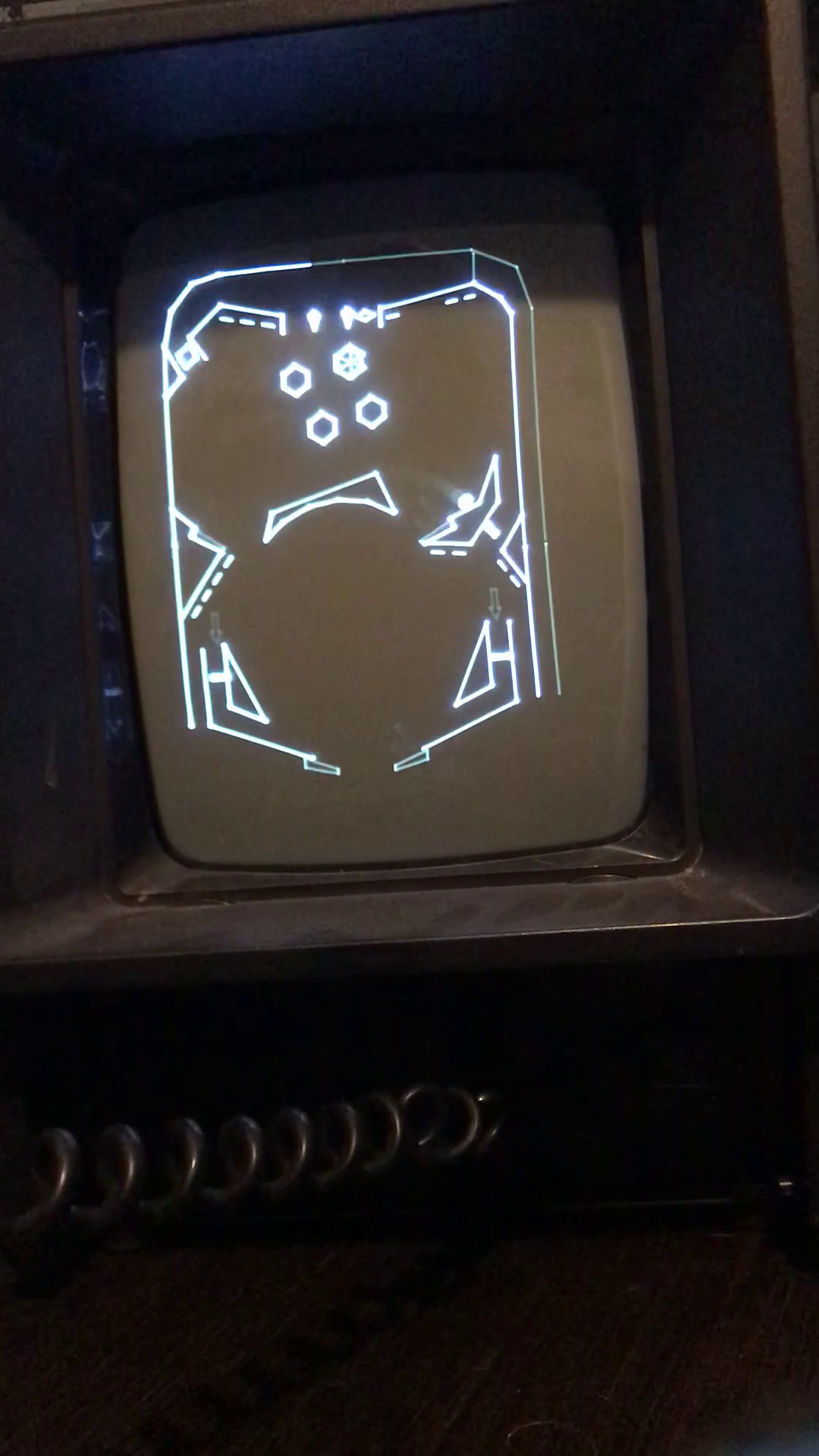
Pinball returned to consoles in 1983 with a series of solid games that hoped to more closely match the coin-op experience than Smith was able to manage. The Vectrex saw Spinball in 1983, a remarkably well-done single screen table that uses the Vectrex’s vertically oriented screen to its advantage, with a variety of targets and bumpers to aim for. This even includes a multiball function, high score targets, four flippers and the all-important nudge function. If this game has any real issue it’s that the ball physics are off by just enough that it can be difficult to predict which way it’s going to move sometimes, which means you’ll get a lot of drains as you get a feel for it. On the upshot, the game does give you five chances, so it’s reasonably forgiving.
Electronic Games certainly thought Spinball was a high-water mark in a November 1983 feature going over pinball games for computers and consoles, indicating that the system’s orientation meant the playfield didn’t need to be squashed down. At the same time the magazine wrote about both Thunderball! and Video Pinball; the writers seemed rather high on Thunderball! despite its chunky graphics, while adding that while Video Pinball suffers from dead zones it also plays like pinball, at least more than it looks or feels like the game. Vidiot also covered Video Pinball in its usual tongue-in-cheek way in an overview of VCS software, essentially calling the game slow-paced and boring.
That same article notes that Intellivision’s promised pinball game had not yet materialized, though it would show up not long after the magazine went to press after spending two years in development due to problems debugging the ball’s movement. This game is interesting, as at first glance it appears to be a single screen table, but by shooting the ball into the two V-shaped lines near the top of the screen, an entrance opens up to a second table; by hitting the drop targets on the upper right of this table, an entrance will open up to the third and final level. Each of these screens provides opportunities to add multipliers and eventually even earn an extra ball, but with how quickly things can move on this game, it’s easy enough to miss out, fall back to the first table and lose your ball entirely… forcing you to start all over. Nevertheless, this ambitious game may be the best of this early era of video pinball titles.
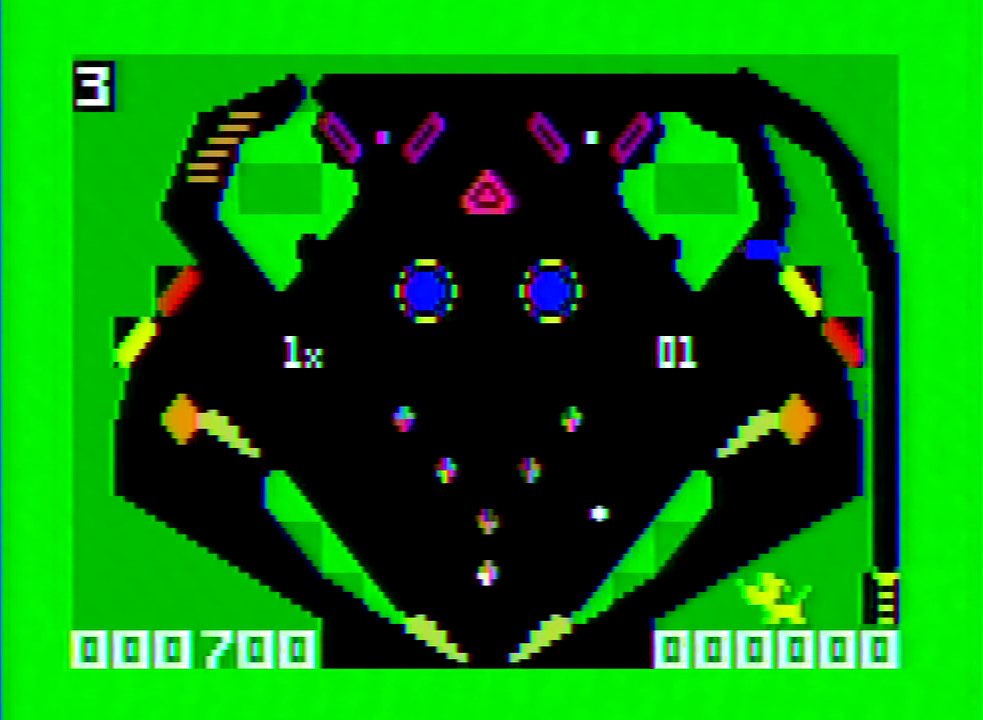
Back on the VCS, 1983 also saw the debut of Bumper Bash by Spectravideo. Essentially a conversion of the computer game of the same name, this release unusually uses the paddle controllers, with each paddle’s button controlling one of the flippers. It’s a solid table, but the unusual control scheme means that you don’t have the ability to nudge the ball, putting you entirely at the mercy of the machine. Also, while this game is more common as a PAL-formatted game in Europe, it’s relatively rare in North America – it appears it may have only been available through the Columbia Record Club, a mail order service, in the US, while also getting a very limited retail release in Canada. Finally, in 1986 Atari Corp released Midnight Magic, which despite the similar name doesn’t have a table at all similar to the Apple II game by David Snider; that said Atari Corp did rerelease the Atari 400 conversion of the Apple game on cartridge in 1987, so it’s entirely plausible they had the name rights and decided to cash in. Regardless of the name, this is probably the most ambitious pinball game on the VCS, with clear visuals, multiple flippers, a target scoring progression and smooth play. This was one of the brand-new games Atari Corp used in its successful fall 1986 push to place the VCS as the low-end entry console for the video game market, and it’s a good choice – Video Pinball was still on the market, but alongside the similarly impressive Solaris and Jr. Pac-Man, Midnight Magic really showcases how far VCS game development had come from a few years prior. Unfortunately, Midnight Magic also lacks any way to nudge the machine, once again putting players at the mercy of angles with no hope of avoiding some drains. Without the ability to nudge in either of these games, they end up being much more difficult VCS games to actually play compared to Video Pinball and miss out on that component of the physicality of playing pinball. You may not be actually nudging your VCS so much as just pressing a button, but Smith recognized the importance of making sure that strategy is included in some fashion.
Now all this said, the future of video pinball games had moved over to computers and Japanese game consoles by this point in gaming history, and there it would remain for years, keeping the genre alive. In 1983 Japan, Sega published Sega Flipper for its SG-1000 console, and the following year Nintendo would release its own Pinball game for both the Famicom and for its Vs. arcade platform. Nintendo’s game featured two screens to its table and a bonus screen that hearkens back to the old paddle pinball games. Successive games on these and other platforms are really outside the scope of this article, but suffice it to say video pinball games have been a console mainstay for decades at this point. And while it is clear that the VCS Video Pinball is not the first such game to show up on console, it being a relatively solid seller on the biggest platform of its day mean it looms larger today than any of its counterparts.
Sources:
Bob Smith, interview with Kevin Bunch, Feb. 3, 2021
Bob Ogdon, interview with Kevin Bunch, Aug. 17, 2020
Andy Modla, interview with Kevin Bunch, June 18, 2021
The Making of Video Pinball, Retro Gamer, Paul Drury, Issue 222
Inside Gaming – Meet Bob Ogdon, the Man Behind the Wizard, Electronic Games, Arnie Katz, May 1982
Pinball – Making Your Own Games, 1970s Style (Part 4), The Memory Machine, Nate Lockhart, May 3 2024
Figure Rebound Effects, How to Design & Build Your Own Custom TV Games, David L. Heiserman, November 1978
Games People Play, The Carletonian, Jim Wrede, May 20, 1971
Catalog of Program Library in the Dartmouth Time Sharing System, Oct. 30, 1972
A Video with Pinball Play, Atari Coin Connection, February 1979
Profile of a Smart Electronic Game: Video Pinball, David Ahl, Creative Computing, July 1978
Atari 2600 and 7800 Sellouts in 86, Computer Entertainer, February 1987
Product Picture, Merchandising, January 1978
Atari sold 850,000 video games in 1977, Weekly Television Digest, April 10, 1978
New Games from Atari, Electronic Exchange, May 1981
Vidiot’s Consumer Guide to Home Games, Vidiot, Annenne Kaye and Simon Fellowes, February-March 1983
Video Pinball Flips Out, Electronic Games, Rick Teverbaugh, November 1983
Critics Choice: Best Designers’ Games, Video Review, Phil Wiswell, September 1983
Astrocade bankruptcy filing, US Bankruptcy Court, Southern District of Ohio, Eastern Division, dated Feb. 23 1984.
Release Date sources:
Video Pinball (VCS), April 1981: Chicago Tribune, April 10 1981; Tampa Times, April 10 1981; Miami Herald, April 16 1981; Anderson Daily Bulletin, April 8 1981
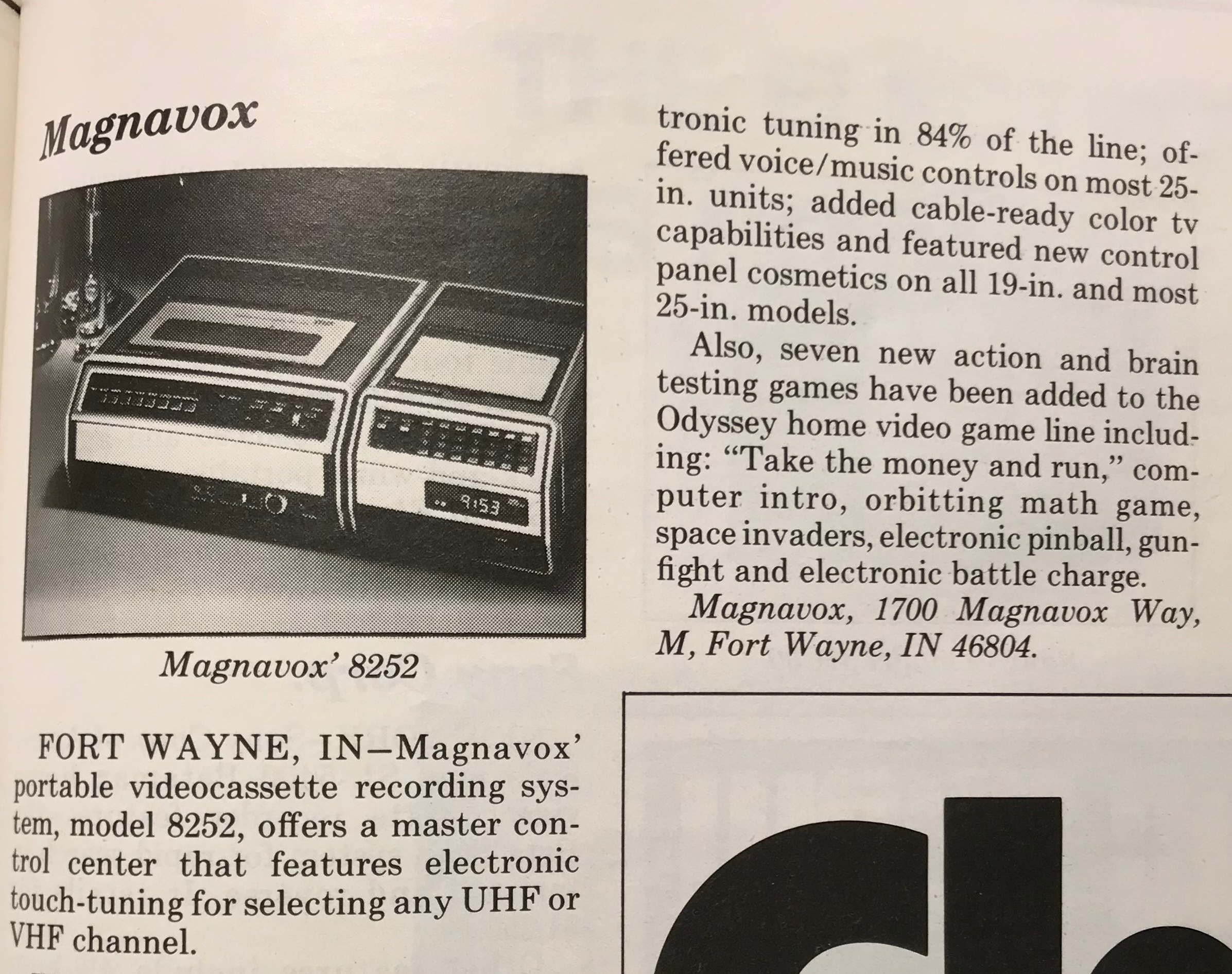
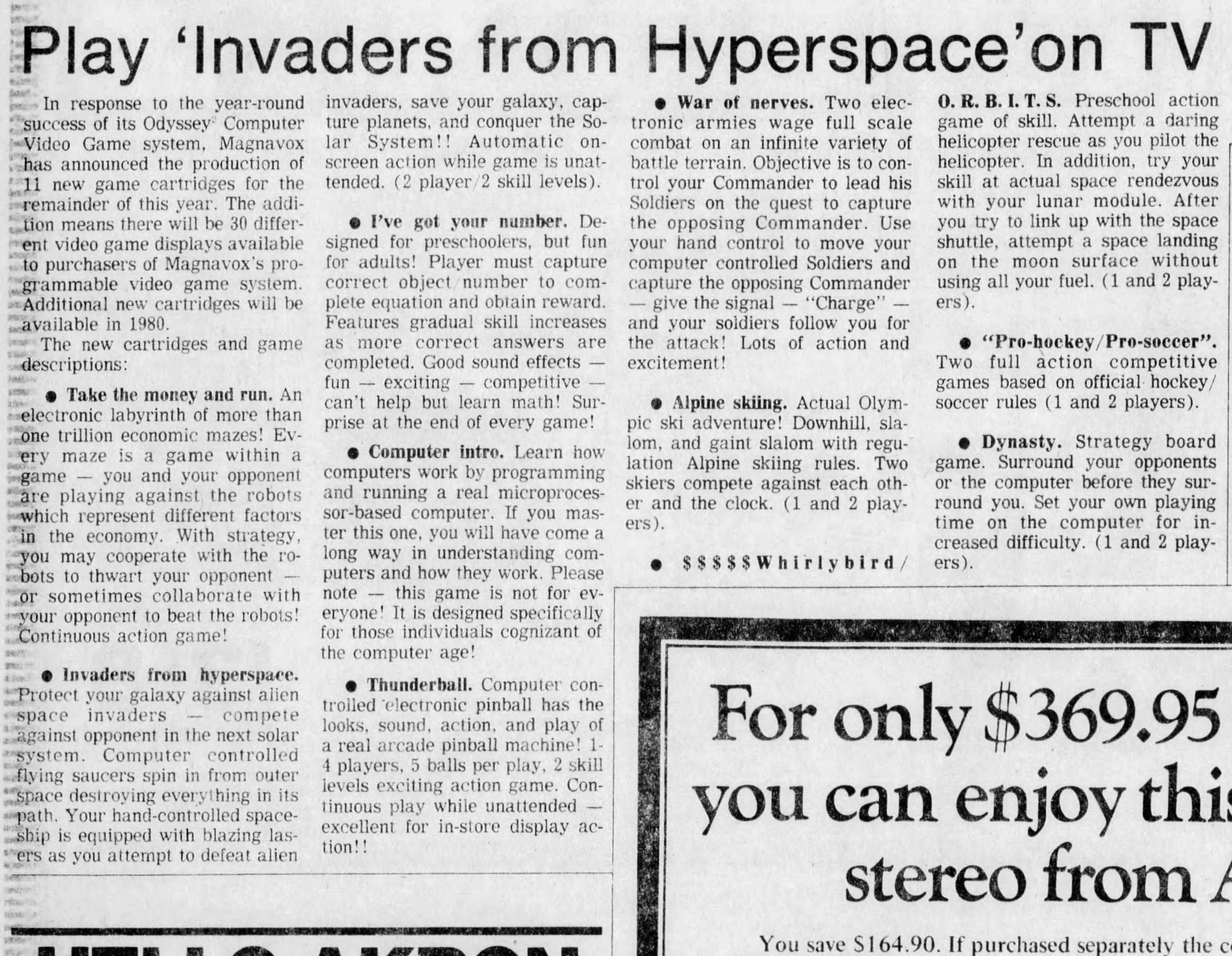
Thunderball!, August 1979: Merchandising, June 1979; Weekly Television Digest, August 13 1979; Akron Beacon Journal, September 13 1979; Alamogordo Daily News, March 20 1980

Bally Pin, October 1979: Arcadian, October 31 1979; Arcadian, January 15 1980
Spinball, July 1983: Computer Entertainer, August 1983
Pinball (Intellivision), October 1983: Computer Entertainer, November 1983; Blue Sky Rangers game list
Midnight Magic (VCS), November 1986: Computer Entertainer, December 1986
Ralph Baer’s Pinball! (O2), July 29-30, 2000: Digital Press CGE 2000 writeup, Odyssey2 homepage review
- of these, only Gee Bee saw release in the west thanks to Sega/Gremlin[↩]
- It is likely that Video Pinball sold a decent number of units despite coming out so late. According to a report in Weekly Television Digest, Atari sold about 850,000 home game units to retailers in 1977, of which around 510,000 were dedicated consoles. Video Pinball was positioned as their marquee title in that line, alongside Stunt Cycle and two variations of Ultra Pong, and given how relatively common the pinball unit is compared to those today one can imagine it did all right for itself among those who couldn’t afford or find a VCS.[↩]
- This was later renamed Astrocade Pinball once the rights to sell the system were licensed to Astrovision and the time frame they could continue to use the Bally name expired.[↩]